A team of Prof. Tingrui Pan from Suzhou Institute for Advanced Study at USTC recently published a paper titled "Blink-Sensing Glasses: A flexible iontronic sensing wearable for continuous
blink monitoring ". Professor Tingrui Pan is the corresponding author of this paper.
In this paper, a wearable system based on a flexible off-power sensor is introduced, which can safely monitor the blink movement for a long time.
The monitoring of physiological signals through the skin is a non-invasive and effective monitoring scheme. Pan's team used a highly sensitive,
flexible dissociation sensor as an input and integrated it into the nose rest of the eyewear to monitor the movement of the orbicularis oculi muscle under the skin deformation,
which in turn monitors the blink of an eye. This is an innovative, safe and effective method for blink monitoring.
The sensitivity of the sensor used in this paper is 0.32nf /mmHg (2-35mmHg). With such a high sensitivity, the movement of the orbicularis oculi muscle can be easily tracked from the inner
corner of the eye and near the dorsum of the nose to monitor blinking. The flexible ion-electronic sensor is placed in the nasal rest, which is a non-inductive, stable and high comfort method.
After the blinking signals were collected, the blinking events in the signals were identified by the variable threshold template matching algorithm, and the periodic blinking characteristics related
to dry eye syndrome were analyzed. The detection accuracy of blink sensing glasses can reach the clinical standard.
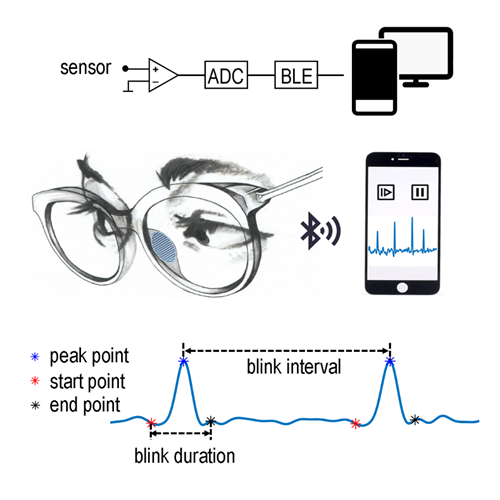
The picture depicts a flexible disenergizing sensor that is integrated into the eyeglass nose rest and transmits the blinking signal to a mobile phone or computer through an analog to electric
conversion and Bluetooth module. The blinking events in the pressure signal are captured by the algorithm and the blinking features are calculated and analyzed.
Although it has always been believed that long-term monitoring of the periodic regularity of eye blink is of great significance for the prevention and intervention of eye diseases, most of the
existing monitoring technologies are limited to short-term monitoring in specific environments and cannot truly achieve long-term daily monitoring of eye blink. Using the flexible disengaging
sensor as the monitoring input, it is integrated on the eyeglass nose rest to monitor the blink. It avoids the problems existing in the current monitoring methods in principle, and has the following
advantages :(1) it can monitor the blink for a long time, safely, stably and effectively; (2) not affected by ambient light; (3) It is rarely affected by differences in facial structure. These advantages are
based on innovative sensing methods and smart placement of sensors.

https://www.sciencedirect.com/science/article/pii/S2589004221003679

